
How to audit your PSX portfolio for Shariah compliance in two minutes
A step-by-step walkthrough of the free portfolio audit: what to enter, what each part of the result means, and how to act on it without turning a screening tool into a trading signal.
If you already hold shares on the Pakistan Stock Exchange, the question is not "which stock is Shariah compliant?" but "how much of what I own is?" The portfolio audit on the home page answers that, along with where your money is concentrated and how each holding is positioned. It is free, needs no account, and forgets what you typed as soon as the result is produced.
This guide walks through it once, slowly, so the two-minute version makes sense afterwards.
What you need before you start
Three things per holding, all of which are on your broker's portfolio statement or in your CDC account:
- the symbol (for example OGDC, not "Oil and Gas Development Company")
- your average buy price in rupees
- the quantity of shares
If you hold a stock in two lots at different prices, use the average, or enter it twice. Up to eight holdings can be audited at once; if you hold more, run it in two passes, largest positions first.
Step one: enter the holdings
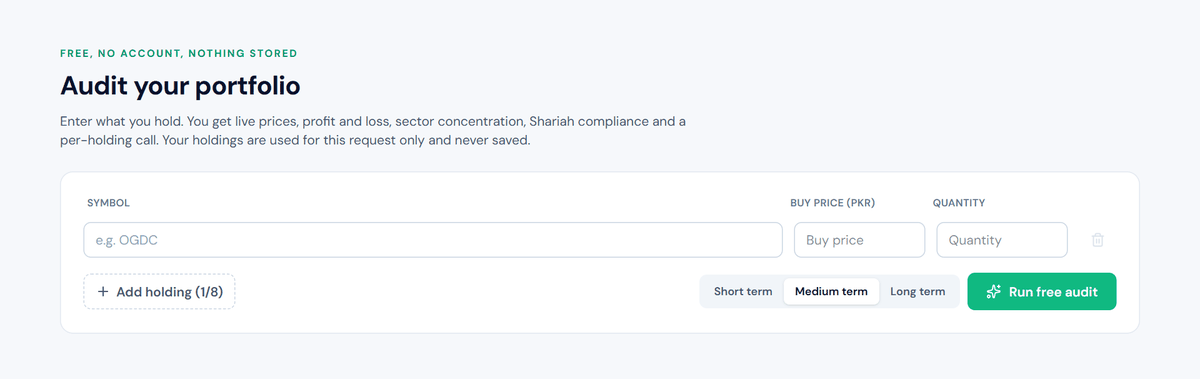
The form on the home page. Nothing you type here is stored.
Start typing a symbol and pick it from the list that appears; the list only contains real PSX symbols, which prevents typos turning into phantom holdings. Enter the buy price and quantity, then Add holding for the next one.
Choose a horizon before you run it. Short term frames the per-holding comment around the next few weeks and the technical position; medium term around the next few months and upcoming events; long term around dividends and the multi-year picture. The compliance result is the same whichever you choose. The horizon only changes the tone of the commentary.
Step two: read the result
The result comes back in a few seconds. At the top are four tiles, then one card per holding.
Market value and unrealised profit or loss. Current value at the latest exchange price against what you paid, in rupees and percent. The prices come from the exchange's data portal and can lag the live market, so treat them as indicative; your broker's screen is the final word.
Shariah compliant. The share of your portfolio's value that sits in companies listed in the KMI All Shares Islamic Index. This is the tile most people run the audit for. Each holding card below carries a green Halal badge if the company is a constituent and no badge if it is not; the reasons a company fails are covered in how to check whether a PSX stock is Shariah compliant.
Largest sector. The sector holding the biggest slice of your money, and its share. Above 40 percent the tile is flagged as concentrated. Pakistani retail portfolios are often 60 to 80 percent in two sectors without the owner noticing, usually because the same WhatsApp group recommended everything. Seeing that as a number is often the most useful line in the whole result.
Per-holding cards. For each stock: the compliance badge, the sector, RSI, support and resistance, the trend, any upcoming dividend or meeting, and a short AI-written comment for the horizon you picked. The comment is generated from the numbers on the card. It is not a recommendation, and it can be confidently wrong, which is why the numbers are shown next to it.
There is a Download PDF button if you want to keep the result, since the site itself keeps nothing.
Step three: decide what, if anything, to do
The audit is a screening tool. Here is how to use it without letting it become a trading signal.
A non-compliant holding is a decision for you, not for the tool. Some investors sell on principle; some hold until the next index review because the company is close to a threshold; some ask a scholar. The audit tells you the status and the source. It does not tell you what your conscience requires.
High concentration is worth acting on slowly. If one sector is most of your portfolio, the fix is usually where the next rupee goes, not a sell-off. The Shariah-compliant picks by sector exist partly so that "what else is compliant in a different sector?" has an answer.
A holding in a downtrend is information, not an instruction. Check the company page for the full picture: the 200-day average, the upcoming events, the sector peers. The guide to reading a stock page covers what each number means.
Privacy, in plain terms
Your holdings are sent to the server, used to compute that one result, and discarded. They are not written to a database, not tied to a cookie, and not visible to anyone afterwards, including the person who runs the site. There is no login because there is nothing to log in to. The privacy policy says the same thing at greater length.
Common questions
Can I audit a portfolio I am thinking of buying? Yes. Enter today's price as the buy price and the audit shows compliance and concentration as if you already held it, with zero profit or loss.
Why is a holding missing from the symbol list? The list covers active equity symbols with a current price. Debt instruments and a few illiquid listings are excluded. If your statement shows a suffixed symbol such as PPLXD, that is the same company trading ex-dividend; enter the plain symbol.
Why does my broker show a different value? Timing. The audit uses the latest price the exchange portal has published, which can be minutes or, after the close, hours behind. Percentages will match closely; rupee totals may differ slightly.
Does the AI ever decide compliance? No. Compliance comes only from the exchange's index list. The AI writes the commentary and nothing else. How our AI picks work explains the boundaries in detail.
Run the audit from the home page. Two minutes, no account, and you keep the result.
Keep reading
SmartSarmaya is an educational research tool, not a licensed financial adviser and not a source of religious rulings. Shariah status reflects membership of the KMI All Shares Islamic Index published by the Pakistan Stock Exchange. Always do your own research.