
How to check whether a PSX stock is Shariah compliant
The Pakistan Stock Exchange publishes its own Shariah-screened list, the KMI All Shares Islamic Index. Here is how the screen works, how to check any company in ten seconds, and what the answer does and does not mean.
Most Pakistani retail investors who care about Shariah compliance find out whether a stock is Shariah compliant (halal) the same way they find out everything else: by asking in a WhatsApp group. Somebody replies "yes bhai, it's fine", nobody says where that came from, and the question is closed.
There is a better source, and it is free. The Pakistan Stock Exchange itself maintains a list of every listed company that passes a Shariah screen, and it publishes that list as an index. If a company is in the index, it passed. If it is not, it did not. This guide explains what the screen checks, how to look a company up, and where the limits of that answer are.
The list the exchange publishes
The KMI All Shares Islamic Index is calculated by the Pakistan Stock Exchange with Shariah screening carried out under the supervision of the advisory board that also governs the better-known KMI-30. The "KMI" stands for KSE-Meezan Index, after the partnership with Al Meezan Investments that created it.
The KMI-30 is the thirty largest and most liquid compliant companies. The All Shares version is the full list: every company on the exchange that clears the screen, regardless of size. That is the one that matters for a "is this halal?" question, because a small company that passes is just as compliant as a large one.
The list is reviewed on a published schedule, normally twice a year, and companies are added or removed as their businesses and balance sheets change. So the answer for a given company can change over time.
What the screen actually checks
The methodology is public. A company has to pass every test, not most of them. In summary:
| Test | What it asks |
|---|---|
| Business activity | Is the core business permissible? Conventional banking, insurance, alcohol, tobacco, gambling and similar activities fail outright. |
| Interest-bearing debt | Is interest-based borrowing below a set share of total assets? |
| Non-compliant investments | Are interest-earning or otherwise non-compliant investments below a set share of total assets? |
| Non-compliant income | Is income from non-compliant sources below a small share of total revenue? |
| Illiquid assets | Are illiquid assets at least a minimum share of total assets, so the share represents a real business rather than a pool of cash? |
| Price versus net liquid assets | Does the market price exceed net liquid assets per share? |
The exact thresholds are set by the index methodology and can be revised, so check the current PSX or Al Meezan documentation if you need the numbers for a formal purpose. The point for an investor is simpler: this is a financial-ratio screen applied by the exchange to audited accounts, not an opinion.
That also explains a pattern people find surprising. A cement company or a fertiliser company can be compliant one year and fall out the next because it borrowed heavily for expansion. A textile exporter can fail on interest income from its cash pile. Compliance is a property of the balance sheet on the review date, not a permanent label.
How to check a company in ten seconds
Every company page on this site states the answer in its first sentence, sourced from the exchange's list.
- Open the stock directory or type the symbol into the search box on the home page.
- Open the company page. The first line under the price reads either "Yes, PPL is Shariah compliant" or "No, HBL is not Shariah compliant", followed by the reason: whether it is a constituent of the KMI All Shares Islamic Index.
- Scroll to the section titled "Is it Shariah compliant?" for the same answer with the caveats spelled out.

The first sentence on every company page. The badge next to the ticker says the same thing.
If you want to see the whole list at once, tick Shariah compliant only at the top of the directory. Everything that remains is a current constituent. Everything that disappears is not.
To check several holdings together, the portfolio audit does it in one pass and also tells you what share of your money is in compliant companies. There is a separate guide on how to audit your portfolio.
How this site uses the list
It is worth being precise about what happens here, because "AI" and "Shariah compliant" in the same sentence should make anyone cautious.
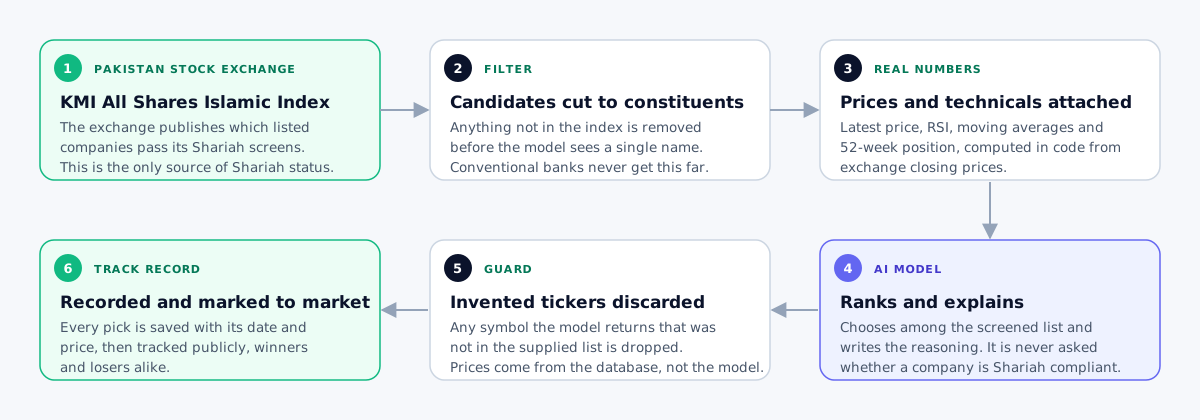
The AI is step four. The Shariah decision is step one, and it belongs to the exchange.
The language model on this site is never asked whether a company is Shariah compliant. Before it sees a single name, the candidate list is filtered to KMI All Shares constituents. It ranks and explains stocks that have already passed the screen, and any symbol it produces that was not on the supplied list is thrown away before it is saved. The full process is described in how our AI picks work.
What the answer does not tell you
Three honest limits.
Index membership is a screen, not a fatwa. The screen is designed by scholars and applied by the exchange, and it is the standard that Pakistan's Islamic mutual funds use. But it is a set of ratio tests. If a particular holding matters to you religiously, ask a qualified scholar about your own situation. This site is not one and does not pretend to be.
Membership lags the accounts. The review uses the latest audited financials, so a company can drift out of compliance between reviews before the list catches up. Some investors treat a company that is close to a threshold with extra care for that reason.
Purification is your job. Even a compliant company may have a small amount of non-compliant income, which is why the screen allows a low percentage rather than zero. Many scholars advise donating that proportion of dividends. The company page cannot do that calculation for you, but the index methodology documents explain the approach.
Quick reference
- Shariah compliant by the exchange's definition: listed in the KMI All Shares Islamic Index.
- Where to check: the first sentence of any company page, or the "Shariah compliant only" filter on the directory.
- How often it changes: at each index review, normally semi-annual.
- What a large index tells you: nothing. The KSE-100 is a size index and includes conventional banks.
- What to do with a "yes": read the rest of the page. Compliance says nothing about whether the price is sensible.
Keep reading
SmartSarmaya is an educational research tool, not a licensed financial adviser and not a source of religious rulings. Shariah status reflects membership of the KMI All Shares Islamic Index published by the Pakistan Stock Exchange. Always do your own research.