
KSE-100 vs KMI-30 vs KMI All Shares: what each PSX index tells you
The KSE-100 measures size. The KMI indices measure Shariah compliance. Confusing the two is how conventional banks end up in 'Shariah-compliant' portfolios. Here is what each index contains and which one to use for what.
"The market was up today" almost always means the KSE-100 was up. It is the number on the news, the one brokers quote, and the one this site's daily brief leads with. It is also the wrong index to use for a question about Shariah-compliant investing, and the two are mixed up often enough that it is worth a short guide.
Three indices, two different questions
The Pakistan Stock Exchange publishes several indices. Three matter to a retail investor.
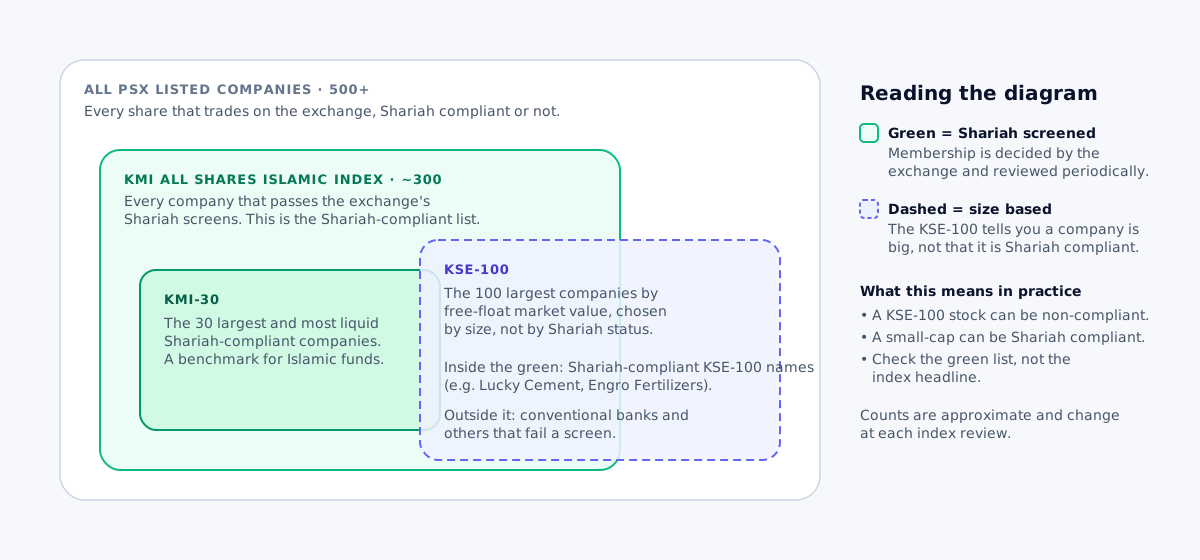
Green boxes are Shariah screened. The dashed box is chosen by size, and it straddles the line.
KSE-100 answers "how is the market doing?" It holds the hundred largest companies by free-float market capitalisation, with rules to ensure sector representation, and it is rebalanced on a schedule. Size is the only criterion that matters. A conventional bank with a huge float is in; a small Shariah-compliant company is not. When the KSE-100 rises one percent, the big companies rose about one percent on a weighted basis, and that is all it says.
KMI All Shares Islamic Index answers "which companies pass the exchange's Shariah screen?" Every listed company that clears the business-activity and financial-ratio tests is a constituent, from the largest to the smallest. This is the list that this site treats as the definition of halal, and the guide to checking a stock explains the screen itself.
KMI-30 answers "how are the large Shariah-compliant companies doing?" It takes the thirty biggest and most liquid constituents of the All Shares list and weights them by free-float capitalisation. Islamic mutual funds benchmark against it; if you hold a Shariah-compliant fund, its factsheet almost certainly compares it to the KMI-30.
Why the KSE-100 is the wrong Shariah filter
Because it was never designed as one. A large share of the KSE-100's weight sits in sectors that fail a Shariah screen outright, conventional banking above all. On any given day the index can be carried up by HBL, UBL and MCB while every compliant company in it falls.
The practical consequence: "it's in the KSE-100" tells you a company is large and liquid. It tells you nothing about compliance. The company page for any constituent states its status in the first sentence; the stock directory can be filtered to compliant companies only.
Why the KMI-30 is not the whole Shariah-compliant universe
The opposite mistake is treating the KMI-30 as the list of Shariah-compliant stocks. It is thirty companies. The All Shares index has around ten times as many. A mid-sized cement company or a small pharmaceutical can be fully compliant and never appear in the KMI-30 because it is not large enough.
If you only ever consider KMI-30 names, you are choosing from the largest tenth of the compliant universe. That is a reasonable preference for liquidity, but it is a preference, not a rule of compliance.
What overlaps
A good number of companies are in all three: large, liquid and compliant. Lucky Cement, Engro Fertilizers, Pakistan Petroleum, Oil and Gas Development, Hub Power and the like have historically been KSE-100 heavyweights and KMI-30 constituents at the same time. Membership changes at each review, so check the current company page rather than relying on memory. This site badges a stock with KSE-100 and KMI-30 next to the ticker when it belongs to either, and states All Shares membership in words.
Which index to watch for what
| You want to know | Use |
|---|---|
| Whether the market as a whole rose or fell | KSE-100 |
| Whether large Shariah-compliant companies rose or fell | KMI-30 |
| Whether a specific company is Shariah compliant | KMI All Shares membership, on its company page |
| How an Islamic mutual fund is doing against its peers | KMI-30, which the fund benchmarks against |
| Which sectors led or lagged today | The sector breadth table in the daily brief |
A note on divergence
On days when banks move sharply, the KSE-100 and KMI-30 diverge, sometimes in opposite directions. A brief that says "the KSE-100 fell 0.8 percent as banks weighed while Shariah stocks rallied" is describing exactly that. If your portfolio is compliant, the KMI-30 line is the better read of what happened to you. The daily brief reports the KSE-100 close first because that is the number people search for, and then explains what moved it.
Quick reference
- KSE-100: the 100 largest by free float. Market barometer. Includes non-compliant companies.
- KMI All Shares: every compliant company. The Shariah-compliant list. Around 300 names, reviewed periodically.
- KMI-30: the 30 largest compliant companies. Fund benchmark.
- To check a company: open its page in the directory. The first sentence is the answer.
Keep reading
SmartSarmaya is an educational research tool, not a licensed financial adviser and not a source of religious rulings. Shariah status reflects membership of the KMI All Shares Islamic Index published by the Pakistan Stock Exchange. Always do your own research.