
How to read the daily PSX brief in three minutes
Two briefs a day, written from exchange data before the open and after the close. What each section is for, how to use the movers and breadth tables, and what a brief can and cannot tell you.
The daily brief is the shortest thing on this site and the most read. It exists because "what did the market do today, and why?" deserves a better answer than a WhatsApp forward with a screenshot of the index. Two editions are published every trading day: a morning brief before the open, setting up the session, and a closing brief after 3:30 pm, explaining what happened.
Both are written by a language model from the exchange's own data, then published automatically, and both carry the name of the editor responsible for them. Here is how to get the most out of one.
The page, top to bottom
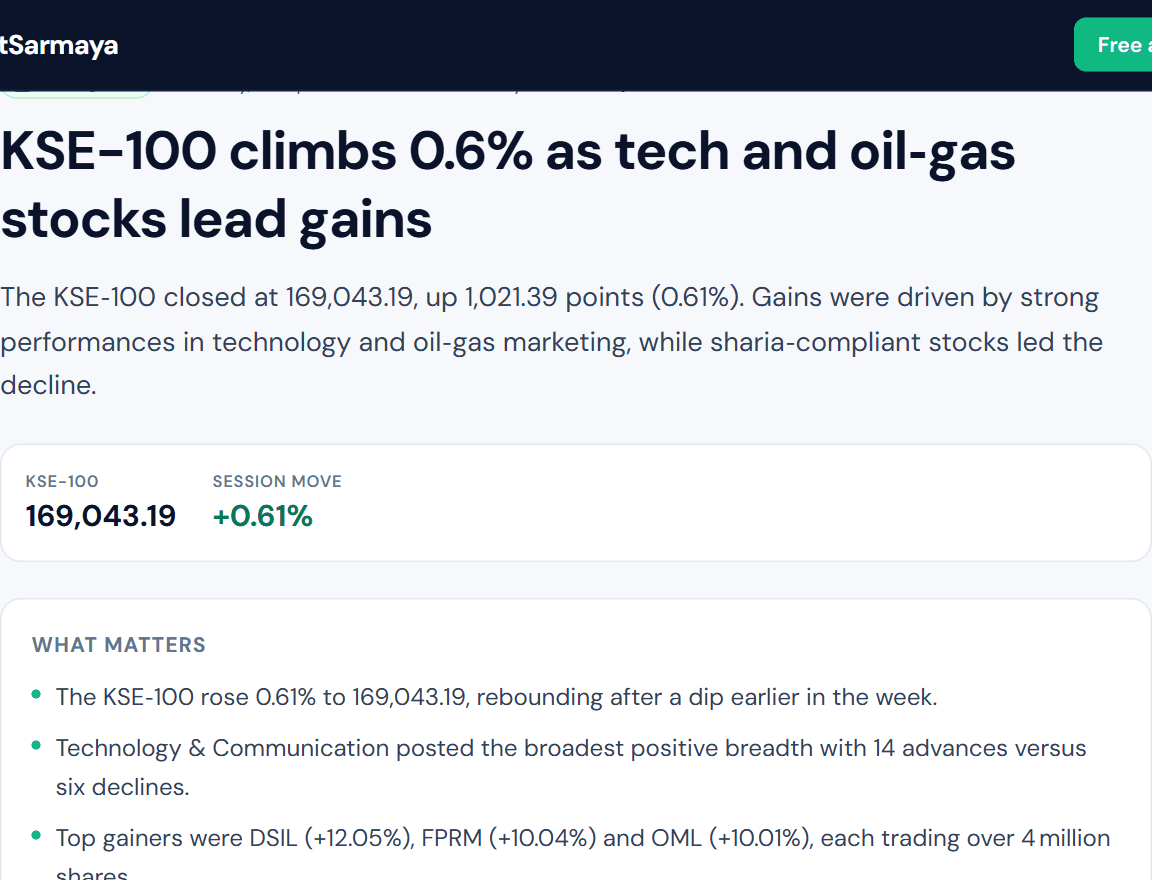
A closing brief. The headline and summary are the whole story; the rest is the evidence.
Headline and summary. The index move and the one thing that explains it, in a sentence and a paragraph. If you read nothing else, read these. They are written to be understood without the rest of the page.
KSE-100 close and session move. The index level and its change for the session. The index guide explains why this number and the Shariah-compliant universe can move in different directions on the same day.
What matters. Five points, in order of importance: the index, which sectors led, the biggest movers with their volumes, what happened to Shariah-compliant names, and any corporate actions worth knowing about. This list is the brief's spine; the body below expands it.
The body. A few paragraphs that connect the points: the sector that led and why, the individual stocks that moved and on what volume, and the announcements ahead. Every number in it comes from the exchange's published data for the session.
Stocks discussed. Every ticker mentioned in the brief, linked to its company page, so a name in the story is one click from its chart, technicals and compliance status.
Morning versus closing
The morning brief is published before the open. It summarises the previous close, the announcements published overnight, the book closures and meetings due that day, and anything in the news that could move the session. It is a setup, not a prediction.
The closing brief is published after the close. It reports what happened: the index, the breadth, the movers, the volume. It is the one to read if you only read one.
Each date has its own page for each edition, so a morning brief written before a big move stays as it was written. Nothing is edited after the fact to look prescient.
Reading the movers
The closing brief names the top gainers and losers with their volumes. Two habits make this useful.
Look at the volume, not just the percentage. A 10 percent move on four million shares is a real repricing. A 10 percent move on forty thousand shares is a thin stock hitting its daily limit on a handful of trades; the PSX has many such stocks, and they lead the movers list more days than not. The brief states the volume for that reason.
Check whether the mover is compliant. The brief says when the losers or gainers are concentrated in Shariah-compliant names, and the company page settles any individual case in its first sentence.
Reading the breadth
"Technology posted 14 advances against six declines" is breadth: how many companies in a sector rose versus fell. Breadth tells you whether a sector move was broad or carried by one heavyweight. A sector up 2 percent with more decliners than advancers is one large stock having a good day, not a sector rally. The home page carries the full breadth table by sector; the brief reports the sectors that stood out.
What a brief cannot tell you
Why, with certainty. The brief connects the day's move to the most visible cause: a sector, a stock, an announcement. Markets move for reasons that are not in the data, and a language model explaining a day's move is doing what every market report does, which is to tell a coherent story after the fact. Treat the explanation as the most likely account, not the confirmed one.
What happens tomorrow. Nothing in a brief is a forecast. The morning edition lists what is scheduled; it does not say how the market will react.
Whether to trade. A brief is context. The picks are the site's attempt at a view, and even those come with a public track record precisely so they are not taken on faith.
A three-minute routine
- Read the headline and summary of the closing brief.
- Scan What matters for anything touching a sector or stock you hold.
- If a holding is mentioned, click through to its company page and check the volume and the Upcoming line.
- Next morning, read the morning brief's list of book closures and meetings due.
That is enough to stay informed without watching a ticker all day, which is roughly the point of the site.
New briefs appear in the archive as they are published, and the latest one is always at the top of the home page.
Keep reading
SmartSarmaya is an educational research tool, not a licensed financial adviser and not a source of religious rulings. Shariah status reflects membership of the KMI All Shares Islamic Index published by the Pakistan Stock Exchange. Always do your own research.