
XD, XB and XR: what the suffixes on PSX tickers mean
When a symbol shows as BOPXD or LUCKXD it is the same company trading ex-dividend. Here is what each suffix means, why the price drops when it appears, and how book closure decides who gets paid.
Open your broker's app during dividend season and you will see symbols that look slightly wrong: BOPXD instead of BOP, LUCKXD instead of LUCK, HICLXB, something ending in XR. They sit next to the real symbol, with a slightly lower price, and they confuse everyone the first time.
They are not different companies. They are the same share, marked to show that a corporate entitlement has just been separated from it.
The three suffixes
XD, ex-dividend. The company has declared a cash dividend and the date has passed after which a buyer no longer receives it. If you buy BOPXD, you are buying Bank of Punjab shares without the dividend that was just announced. Whoever owned the shares before the ex-date gets the cash.
XB, ex-bonus. The same idea for bonus shares. A company issuing, say, a 10 percent bonus gives existing holders one free share for every ten. After the ex-date the share trades XB: a buyer gets the share but not the bonus.
XR, ex-rights. The company is offering existing holders the right to buy new shares, usually at a discount, in proportion to what they hold. After the ex-date the share trades XR, and the rights themselves trade separately for a while under their own symbol, often the company's ticker followed by R.
The suffix appears from the ex-date until the book closure period ends, then disappears and the symbol returns to normal. On this site, a suffixed symbol's page points you to the company's own page, since the two are one share.
Why the price drops on the ex-date
Because the money left. If a share worth Rs 100 pays a Rs 5 dividend, the company is worth Rs 5 per share less the moment the dividend is fixed to previous holders. The share opens ex-dividend around Rs 95, all else being equal. Nobody lost anything: the previous holder has Rs 95 of share plus Rs 5 of cash on the way.
This matters for two reasons. First, buying a stock the day before it goes XD to "capture" the dividend does not work; you pay for the dividend in the price. Second, a stock page that shows a sharp one-day fall on an ex-date is not showing bad news. Check the events line on the company page before reading anything into it.
Bonus issues work the same way in proportion. A 10 percent bonus means a holder has 10 percent more shares, so each share is worth about 9 percent less. The total is unchanged.
Book closure: who gets paid
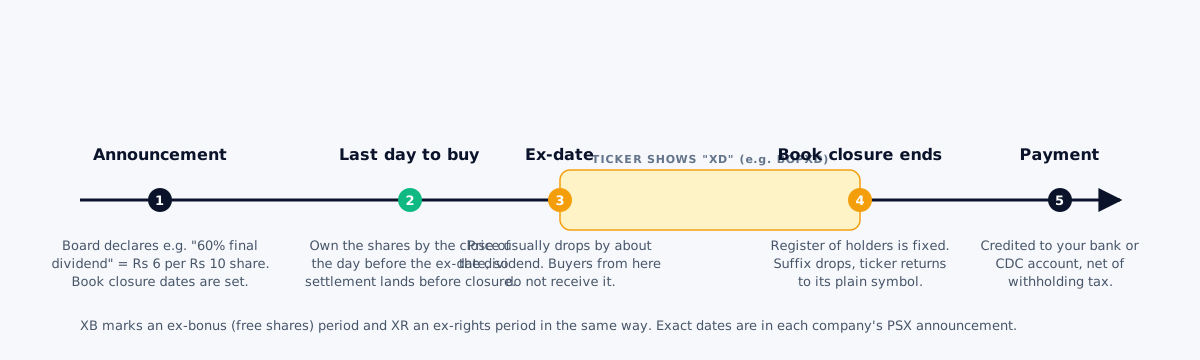
The suffix lives between points three and four.
A company announces a dividend together with a book closure period: a range of dates during which its register of shareholders is frozen. Whoever is on the register when it closes gets the entitlement. Because a trade on the PSX takes two working days to settle, you need to have bought the share early enough for the purchase to be recorded before the register closes. The exchange sets the ex-date accordingly and marks the symbol from that day.
In practice: buy before the ex-date, you receive the dividend. Buy on or after it, you do not. The company page lists upcoming book closures under Upcoming, and the home page collects the next few weeks of them under dividends and corporate actions.
How the payout is written
PSX announcements express dividends as a percentage of the share's face value, which for most companies is Rs 10. So:
| Announcement | Means |
|---|---|
| 60% final dividend | Rs 6.00 per share |
| 25% interim dividend | Rs 2.50 per share |
| 10% bonus | 1 free share per 10 held |
| 20% right at Rs 15 | The right to buy 2 new shares per 10 held, at Rs 15 each |
"Interim" means paid during the financial year; "final" means declared with the annual results. A company can pay several interims and a final in one year. The (D) after a payout on this site marks a cash dividend.
A few companies have a different face value, which changes the arithmetic, so if a percentage looks unusually generous, check the face value in the company's announcement on the PSX website.
What to do with a suffixed symbol
- Looking a company up: use the plain symbol. The directory lists BOP, not BOPXD, and BOPXD's page will send you there.
- Entering holdings in the portfolio audit: use the plain symbol too. Your broker will show the suffix for a few days; the holding is the same.
- Comparing prices: BOP and BOPXD trading side by side at slightly different prices is normal during the closure period. The gap is the entitlement.
- Reading a chart: a step down on the ex-date is the dividend leaving, not a sell-off.
Rights and preference shares are different
Two things that look similar are not the same share. Rights (a symbol ending in R, such as SGPLR) are the tradable entitlement to buy new shares; they expire, and they are not the company's stock. Preference shares (usually marked "Pref" or ending in CPS) are a separate class with different terms. Neither carries the ordinary share's Shariah status automatically, and this site keeps them out of its Shariah-compliant lists for that reason. The guide to dividends covers what a rights issue means for a holder in more detail.
Keep reading
SmartSarmaya is an educational research tool, not a licensed financial adviser and not a source of religious rulings. Shariah status reflects membership of the KMI All Shares Islamic Index published by the Pakistan Stock Exchange. Always do your own research.